TalkSibi — a language exchange alternative
Why people look for an alternative
The most common reason people arrive on this page is the drop-off: a promising exchange that goes quiet after a couple of messages, repeated until the app stops getting opened. The second is that they want to practise speaking and keep finding themselves typing. The third is free-tier limits that bite before you have worked out whether the community suits you.
We will not publish a feature table for HelloTalk. We cannot verify another company's current app from here, a table written from the outside is out of date within a release, and getting one row wrong would be both unfair and a good reason for you to distrust the rest of the page. Instead: here is precisely what TalkSibi is, and here are the questions to ask of either.
What TalkSibi is, factually
- Free to use, no card. Unlimited chat, unlimited voice calls, the language games, the live parties, clubs and partner matching are all free, with no paid plan and nothing to unlock. Translation and the AI coach have a daily allowance, because each of those costs money every time it is used.
- 480+ languages.
- Text chat with one-tap translation on the other person's messages.
- Voice and video calls with live captions translated into your language. Camera always optional.
- Live voice parties — drop-in rooms with several members, a host managing the mic, and listening allowed indefinitely.
- Six word games for learners — Word Spies, Word Race, Word Chain, Guess the Word, Mind Meld, Who is the Spy?
- AI language experts, 24/7, holding real conversations with gentle correction mid-flow, free like everything else.
- AI learning plans — five lessons built around your language, level, daily minutes and focus — plus IELTS and TOEFL material.
- 18+ only, every profile photo-checked. Report and Block on every screen.
- Moderation you can question. You are told which rule was broken; a human reads appeals; no permanent ban is automated.
- Runs in any browser, plus iOS and Android apps. Nothing to install if you do not want to.
The thing we built differently on purpose
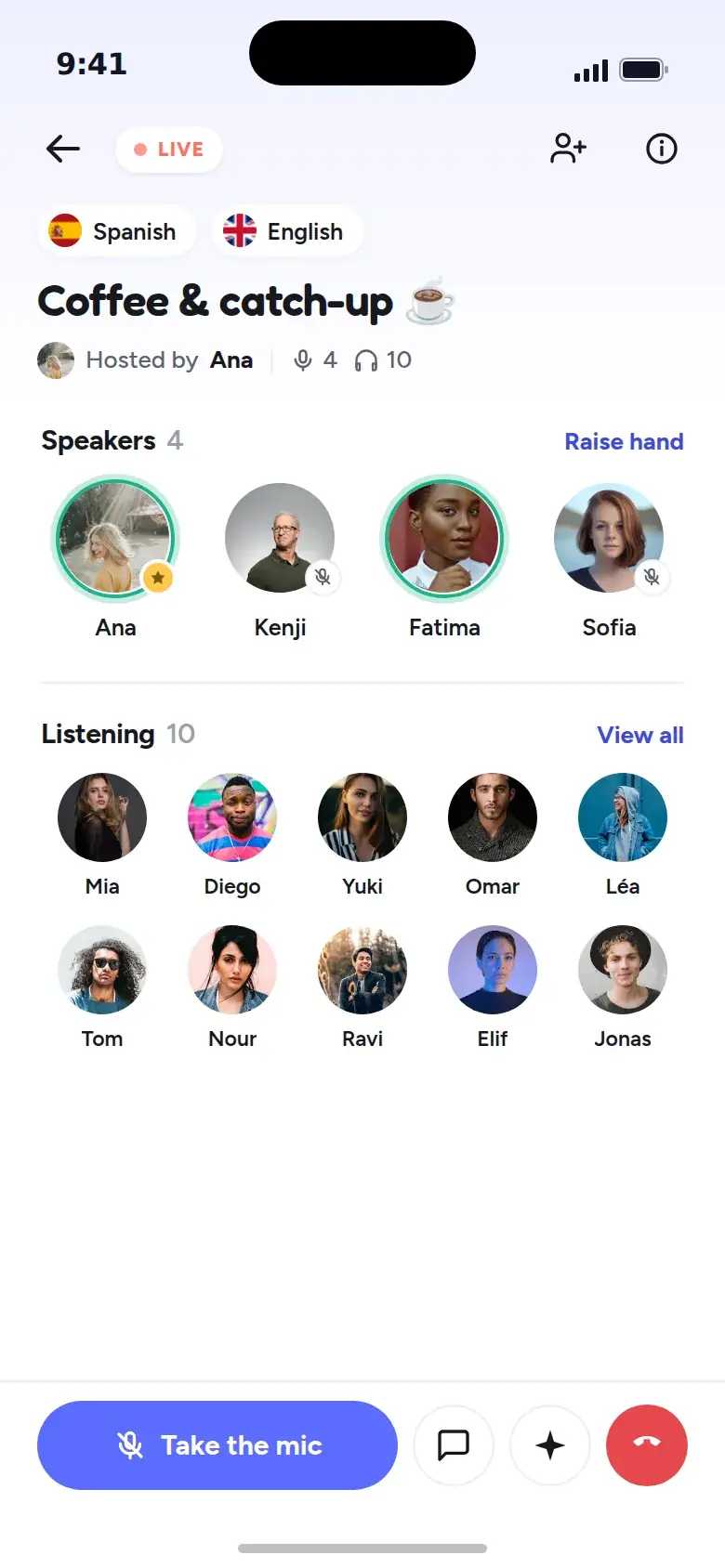
TalkSibi is arranged around live voice, not text. Text chat exists and it is good — one-tap translation on the other person's messages — but it is treated as the way in, not the destination. The centre of the product is the drop-in voice party: a room with several members in it where you can listen indefinitely, raise a hand for the mic when you want it, and step back down without explaining yourself.
That design is a response to the two failure modes of text-first exchange. Threads die, because a text conversation with a stranger needs constant manufactured effort from both sides. And typing does not make you able to speak — you can hold fluent written conversations for a year and still stall out loud, because speech under time pressure is a separate skill.
The other deliberate piece is the AI language experts, free and available 24/7, correcting gently inside the conversation. They exist for the honest reason that no community is fully staffed at 3am in every language, and the nights nobody is online are exactly when people quietly stop.
What to check in any language-exchange app
Run these against TalkSibi and against anything else you are weighing up. They are the questions that decide whether you are still using an app in three months.
- Is the free tier usable or a teaser? Specifically: can you send a first message to someone you have not matched with, and can you hear a language spoken live, without paying?
- What happens at 2am in your language? Every exchange app is good at peak time in big languages. The gaps are what break the habit.
- Can you practise speaking, or only typing? Text chat is the easy feature to build. Live voice with several people in a room is not.
- How do you get corrected? And can you set how much you want?
- Who is allowed in? Age limits, and whether profiles are verified at all.
- What happens if you are reported — or banned? Are you told which rule you broke? Is there an appeal a human reads? This is the question nobody asks until it is too late.
- Can you export or delete your data? And how many taps is it.
- Is it a dating app wearing a language badge? You will know within an hour of joining.
Who TalkSibi actually suits
People who want to speak, will try a voice room, and are tired of exchanges that fizzle in text. People practising at unsociable hours or in a thinner language pool. People who need to listen for a while before they say anything — that is a supported way to use the app, not a failure to use it. And people who care that a moderation decision comes with a reason and an appeal a human reads.
It suits you less if you want a graded course, or if you mainly want a text pen-pal, which plenty of apps do well.
For a longer side-by-side, see TalkSibi vs HelloTalk.
Who is here, and how it is kept safe
TalkSibi is for adults aged 18 and over. Every profile is photo-checked before it can message anyone, and Report and Block are on every screen — profile, chat, call and party. Calls are not recorded and parties are not monitored, which is why reporting matters; reports are confidential and a person reads them. The community guidelines set out what is expected and what happens when someone ignores it.
Try it free
Join a live party and listen. That is the fastest way to tell whether this is the app you have been looking for. Join TalkSibi free — 18+, photo-checked, no card needed.
Keep reading
TalkSibi vs HelloTalk · Tandem alternative · Live language parties · Live language practice · Best free language exchange apps
Common questions
What is a good alternative to HelloTalk?
TalkSibi is a free language-exchange community built around live voice: drop-in voice parties you can listen in without speaking, voice and video calls with translated live captions, six word games for learners, and AI practice partners available 24/7.
Is TalkSibi free?
Yes. Chat, live voice parties, the games and the AI partners are all free, with a daily allowance on a few of them. There is no paid plan, no card and nothing to unlock.
What makes TalkSibi different?
It is arranged around live voice rather than text. Text chat is the way in; the centre of the product is a drop-in voice room where you can listen as long as you like before taking the mic.
Why do language exchange chats always go quiet?
Because a text conversation with a stranger needs manufactured effort from both people every single time. Live rooms and games remove that — the conversation is already happening, or the game supplies the subject.
Can I practise if nobody is online in my language?
Yes. AI language experts are free and available 24/7, and hold a real conversation in your target language with gentle correction as you talk.