Online language exchange
What a language exchange actually is
A language exchange is a swap. You speak English and you are learning Spanish; someone else speaks Spanish and is learning English. You spend part of your time in their language and part in yours, and you both leave better off. That symmetry is the whole trick — nobody is a student being tolerated, and nobody is an unpaid tutor. It is the oldest way to learn a language and still the one that produces people who can hold a conversation rather than pass a test.
TalkSibi is a free language-exchange community where you practise a language with real native speakers over chat, voice and video calls and live voice parties. It is free, and it is not a course: there is no syllabus, no streak to protect and nothing to complete. There are people, and there are ways to talk to them.
How it works on TalkSibi
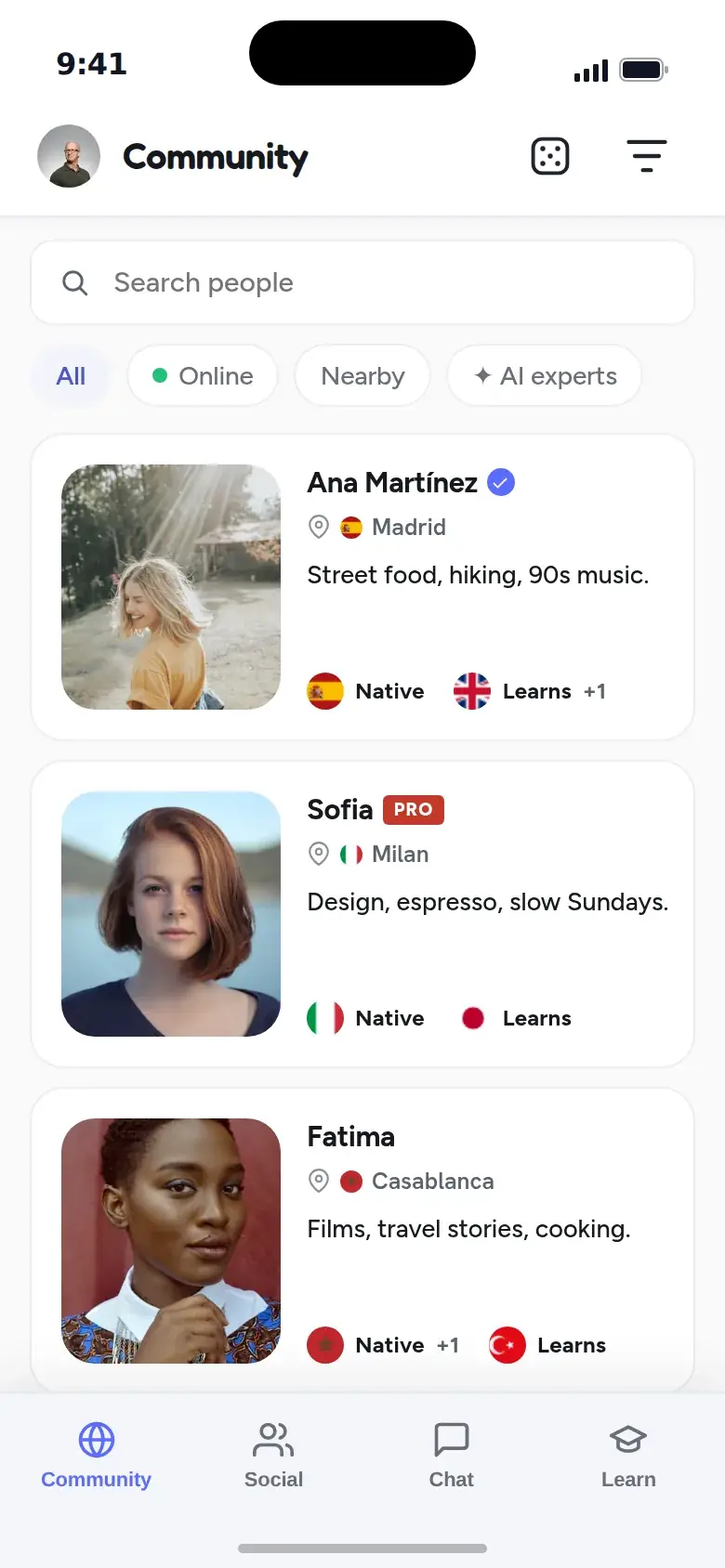
- Say what you speak and what you want to practise. 480+ languages, and you can list more than one of each.
- Look through the community wall. Real members learning the language you speak, filtered by who is online now or who is nearby. You are looking for someone whose pair matches yours.
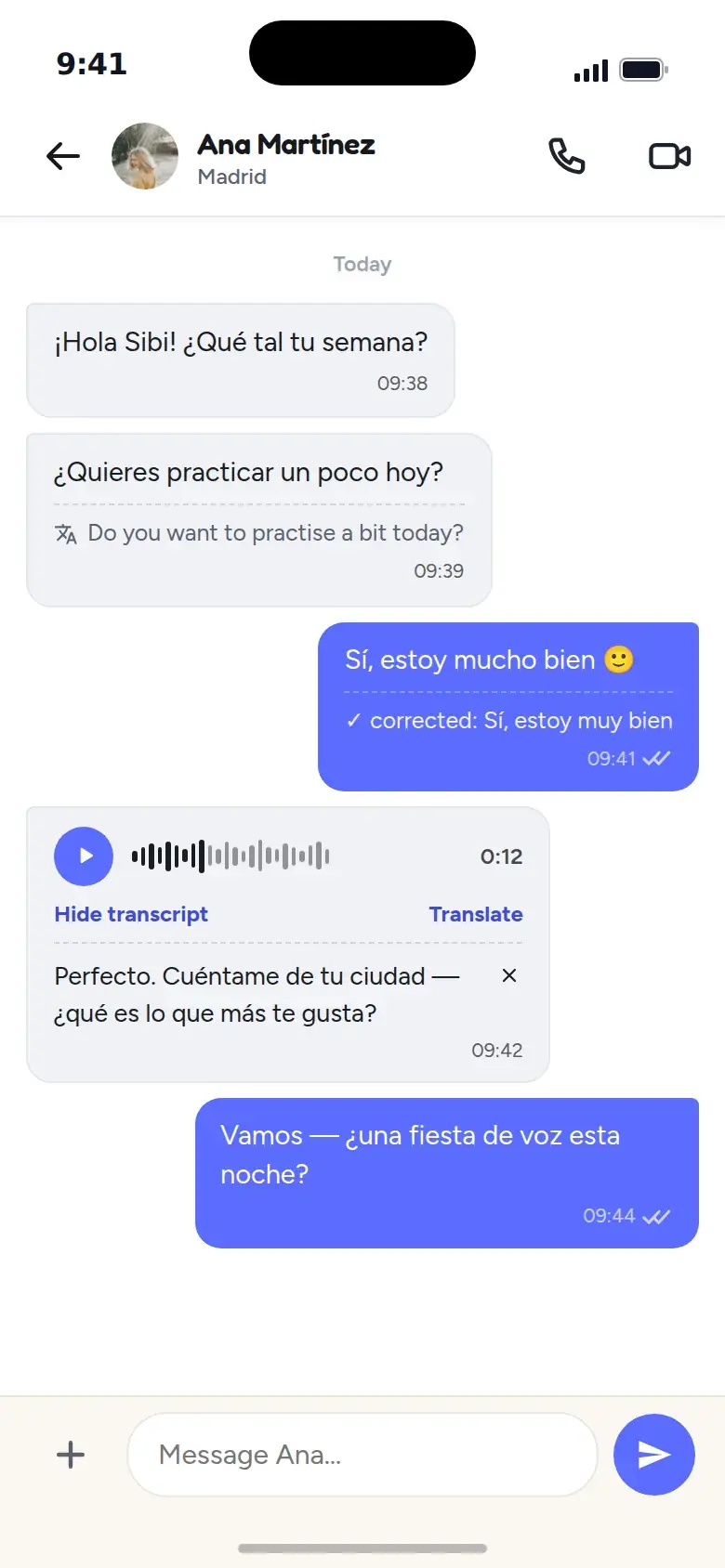
- Start in text if speaking feels like a lot. Chat has one-tap translation on the other person's messages, so an unfamiliar language is never a dead end.
- Move to voice when you are ready. Voice and video calls carry live captions, translated into your language as you go, which is what makes a fast native speaker followable.
- Or skip the one-to-one entirely and drop into a live language party, where you can listen to a room before you say a word.
Finding someone who actually replies
The hard part of language exchange has never been the concept, it is the drop-off: a pleasant first message, two replies, silence. A few things help, and they are the same on any platform. Message people who are online rather than broadcasting to everyone. Open with something specific to their profile instead of "hi, exchange?". Ask a question that cannot be answered with one word. And offer a time rather than a vague "sometime" — "20 minutes tomorrow evening, half in each language" gets a yes far more often than an open invitation.
Two things on TalkSibi are built around that problem specifically. The online and nearby filters mean you are talking to people who are actually at their phone. And the AI language experts mean a quiet Tuesday at 1am is still practice, rather than the evening you give up — they hold a real conversation in your target language and correct you gently while you are in it, so the habit survives the gaps between humans.
What to do in an exchange when you run out of things to say
Everyone runs out. Describe your day in the target language and let the other person fix it. Pick a photo each and describe it. Argue about something harmless. Or use one of the six word games — they hand you a reason to talk, which is easier than manufacturing one. More on the games.
Who is here, and how it is kept safe
TalkSibi is for adults aged 18 and over. Every profile is photo-checked before it can message anyone, and Report and Block are on every screen — profile, chat, call and party. Calls are not recorded and parties are not monitored, which is why reporting matters; reports are confidential and a person reads them. The community guidelines set out what is expected and what happens when someone ignores it.
What it costs
TalkSibi is free to use, and no card is needed. Unlimited chat, unlimited voice calls, the language games, the live language parties, clubs, partner matching and the IELTS and TOEFL material are all free — there is no paid plan and nothing to unlock. Translation and the AI coach have a daily allowance, because each of those costs money every time it is used. Full detail on pricing.
Where it runs
TalkSibi works in any modern browser on a phone, tablet or laptop — nothing to install — and there are apps for iOS and Android if you would rather have one. You can also add the site to your home screen and it behaves like an app.
Start a language exchange
Pick your languages, find someone whose pair matches yours, and say something in the wrong tense. Join TalkSibi free — 18+, photo-checked, no card needed.
Keep reading
Live language parties · Live language practice · Speaking practice · Language games · The community · What is a language exchange? · How to find a partner
Common questions
What is a language exchange?
A language exchange is a swap between two people who each speak the language the other is learning. You spend part of the conversation in their language and part in yours, so both of you are practising and neither is doing the other a favour.
Is TalkSibi free to use for language exchange?
Yes. TalkSibi is free to use and no card is needed — unlimited chat, unlimited voice calls, the language games and the live language parties are all free. There is no paid plan and nothing to unlock. Translation and the AI coach have a daily allowance, because each of those costs money every time it is used.
Which languages can I practise?
Over 480, including English, Spanish, French, German, Italian, Portuguese, Japanese and Korean. You can list more than one language you speak and more than one you are learning.
Do I need to speak well before I start?
No. Most people on TalkSibi are mid-learning and expect broken sentences. You can start in text chat with one-tap translation, listen in a live party without speaking, or practise with an AI partner first.
How is a language exchange different from a tutor?
A tutor plans your learning and you pay for their time. An exchange is free and mutual — you get real unscripted conversation and cultural context, but no curriculum. Plenty of people do both.
What if nobody is online when I want to practise?
AI language experts are available 24/7 and hold a real conversation in your target language, correcting you gently as you talk. They are free, with a daily allowance.