Speaking practice, without the fear
The real problem with speaking practice
People who have studied a language for years often cannot order a coffee in it, and conclude they need more study. Usually they need the opposite. Speaking is a motor skill, not a knowledge one: the hesitation is not a missing word, it is the half-second of self-monitoring that happens before you commit to a sentence. The only thing that shortens that half-second is speaking, badly, repeatedly, until the stakes stop feeling high.
So the useful question is not "how do I get better at speaking" but "how do I get enough low-stakes speaking to stop being frightened". That is the thing TalkSibi is arranged around.
A path that starts where you actually are
- Text first, if you need it. Chat with one-tap translation on the other person's messages. It gets you composing sentences in the language with no time pressure, and it builds enough of a relationship that a first call is with someone rather than a stranger.
- Listen in a live party. Drop into a voice room and do not speak at all. You are not announced and nobody calls on you. Hearing the language at full speed between other people is the step most learners skip, and it is why native speakers sound "too fast" for so long.
- Practise with an AI partner, alone. AI language experts hold a real conversation at any hour and correct you gently mid-flow instead of grading you at the end. Nobody is watching, nothing is at stake, and you can be as bad as you like — which is why this step unsticks people who cannot face a human yet.
- Take the mic in a party. Raise your hand, say a few sentences, step back down. Short and voluntary.
- Call one person. Voice first, camera optional and always optional. Live captions translated into your language mean a fast reply does not end the conversation.
Plenty of people move through that in a fortnight. Some stay at step three for a month, which is fine — it is still speaking.
Getting corrected without being discouraged
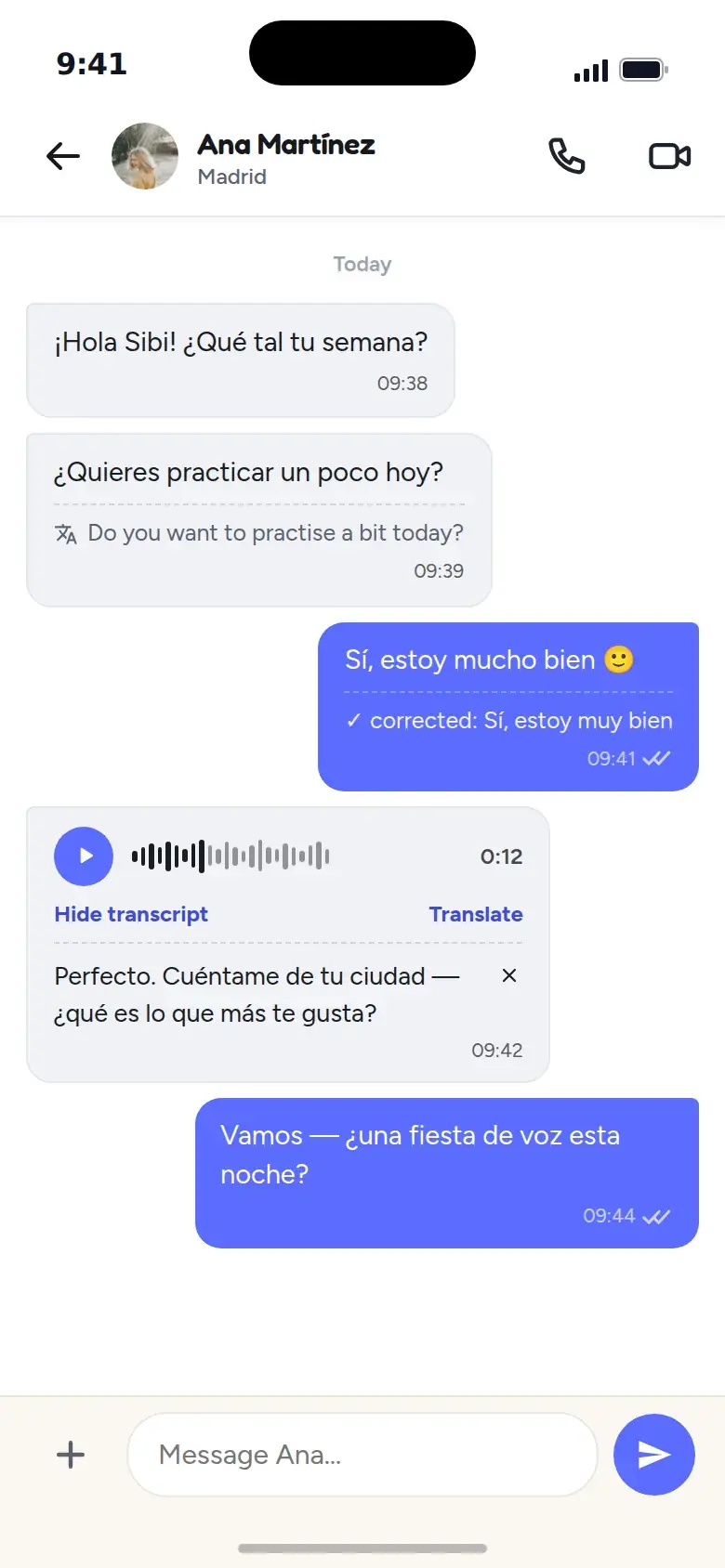
Correction is where speaking practice usually goes wrong, in both directions: partners who fix every article until you stop trying, and partners who are so polite you leave with the same mistakes you arrived with. Say what you want at the start — most people are glad to be told. "Stop me when the meaning breaks, ignore my prepositions" is a completely reasonable instruction, and so is the opposite.
The AI experts are deliberately built at the gentle end: they correct inside the conversation and then carry on, so you are not reading a report card. If you want a structured version instead, the app will generate a five-lesson plan around your language, level, the minutes you actually have and whether you want to work on speaking, listening, vocabulary, idioms or grammar.
If you are preparing for an exam
For IELTS or TOEFL speaking, the same logic applies with a clock on it — you need volume of unscripted speech, not more model answers. There is hand-picked IELTS and TOEFL guidance in the app alongside free resources for each section, and the speaking part is best practised against a real person who will interrupt you.
Who is here, and how it is kept safe
TalkSibi is for adults aged 18 and over. Every profile is photo-checked before it can message anyone, and Report and Block are on every screen — profile, chat, call and party. Calls are not recorded and parties are not monitored, which is why reporting matters; reports are confidential and a person reads them. The community guidelines set out what is expected and what happens when someone ignores it.
What it costs
TalkSibi is free to use, and no card is needed. Unlimited chat, unlimited voice calls, the language games, the live language parties, clubs, partner matching and the IELTS and TOEFL material are all free — there is no paid plan and nothing to unlock. Translation and the AI coach have a daily allowance, because each of those costs money every time it is used. Full detail on pricing.
Where it runs
TalkSibi works in any modern browser on a phone, tablet or laptop — nothing to install — and there are apps for iOS and Android if you would rather have one. You can also add the site to your home screen and it behaves like an app.
Start speaking practice
Begin wherever you are — text, a party you only listen to, or an AI partner at midnight. Join TalkSibi free — 18+, photo-checked, no card needed.
Keep reading
Live language practice · Online language exchange · Live language parties · Language games · Overcoming the fear of speaking · Practising at home
Common questions
How can I practise speaking a language if I am too nervous to talk to people?
Start without people. Listen in a live voice party without speaking, or practise with an AI language expert, which holds a real conversation at any hour and corrects you gently with nobody watching. Most members move on to real calls from there.
How do I get better at speaking a language?
Volume of low-stakes speaking, more than extra study. Speaking is a motor skill — the hesitation is self-monitoring, not a missing word, and it only shortens by speaking badly and often until the stakes stop feeling high.
Will people correct my mistakes?
As much or as little as you ask for. Saying up front what you want works well — for example, to be stopped only when the meaning breaks. The AI partners correct gently inside the conversation rather than grading you afterwards.
Can I practise speaking for IELTS or TOEFL?
Yes. The app has hand-picked IELTS and TOEFL guidance with free resources per section, and the speaking section is best practised against a real person who will interrupt you.
How often should I practise speaking?
Short and frequent beats long and rare. Twenty minutes several times a week does more than a two-hour session once a fortnight, mostly because it keeps the habit alive.