How to Play Word Spies: Codenames-Style Rules Explained
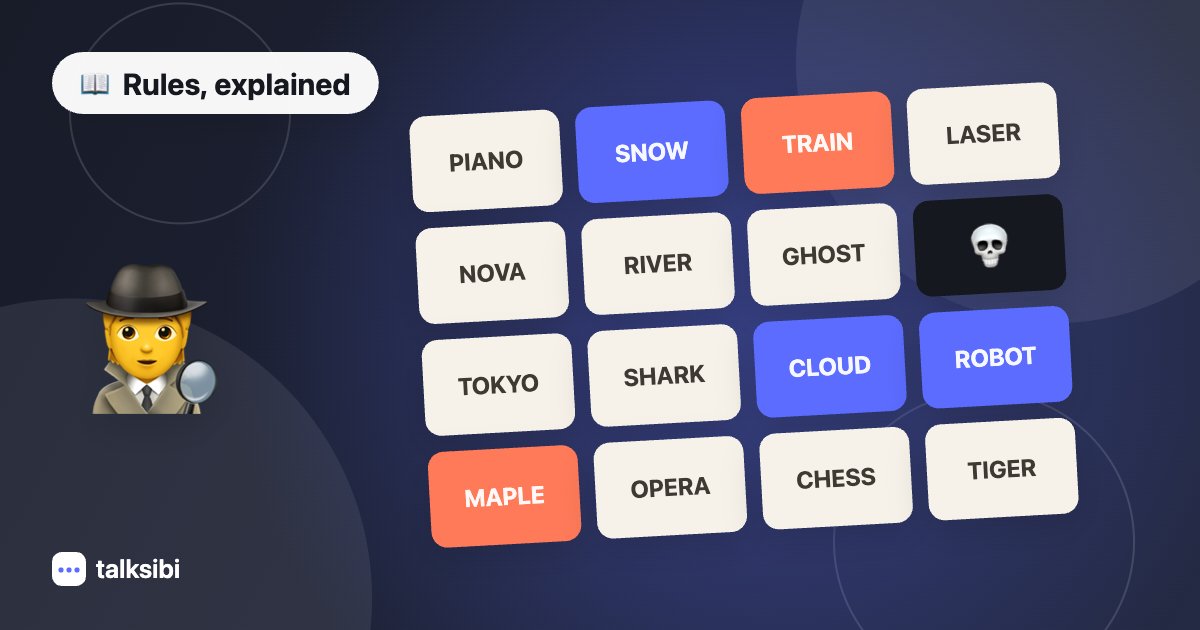
Word Spies is TalkSibi’s own team word game, free on any phone or laptop. If you have played Codenames you will recognise the shape of it — two teams, a grid of words, spymasters giving one-word clues — and if you have not, it takes about ninety seconds to click. Here are the rules the way Word Spies plays them, with the few places it differs from the board game pointed out as we go, and then everything we know about small groups, winning and house rules.
Jump to: two players · four players · how to win · giving clues · house rules
The board
Twenty-five words in a five-by-five grid. Eight belong to Red, eight to Blue, eight are neutral, and one is the assassin. Only the two spymasters can see which is which; everyone else sees twenty-five plain words. The team that goes first is picked at random.
If you know Codenames, this is the first difference: there, the team that starts has one word more than the other. Word Spies deals both teams eight and leaves the spare card neutral, so the board is even and easier to read at a glance.
Starting a room
Open Word Spies, type your name and tap New game. You get a four-letter code and an invite link to send round; everyone else types their name and the code on their own phone, tablet or laptop. No account is needed to play. Everyone picks Red or Blue, and each team needs one spymaster and at least one guesser. If nobody wants to choose, the host can tap Spin the wheel, which shuffles everyone in the room across both teams and picks the spymasters.
Before starting, the host can set a turn timer — one, two or three minutes, or none — and the language the board is dealt in. Then Start.
The clue
The spymaster types one word and picks a number: how many of the team’s words the clue points at. Say your words include SWING and SLIDE. PLAYGROUND, 2 is a good clue — unless PARK is on the board and belongs to the other team, in which case you have just handed them a word. Looking at the whole board before you speak is the entire skill.
The clue is a single word, and the game will not accept one that is still showing on the board. The rest is convention: no gestures, no extra hints, no meaningful looks. The game cannot police your eyebrows, so that part is up to the table.
The guessing
The guessers talk it through — out loud on the call, or in the game chat — and then tap words one at a time.
- Your team’s word: it turns your colour and you can keep going.
- A neutral word: your turn ends.
- The other team’s word: your turn ends, and you have just found one of theirs for them.
- The assassin: your team loses, there and then.
You can tap up to the clue’s number plus one; the extra guess is for picking up a word you missed from an earlier clue. You can stop at any point with End turn, and if a timer is set and it runs out, the turn passes to the other team.
Winning
The first team to uncover all eight of its words wins — and that counts even when the other team uncovers your last one for you. The assassin is the only way to lose outright. When a game ends the host taps Play again for a fresh board, and the score at the top keeps a running tally for as long as the room stays open.
Three rookie mistakes, while we are here. Spymasters giving clever clues nobody understands: clear beats clever. Guessers tapping fast without discussing: the debate is the game. And forgetting the assassin exists: before every tap, ask whether the clue could possibly mean that word.
Playing with two people
The team game needs four, because each side needs someone to give clues and someone to guess. Two of you play the same side against the board instead. Both sit on one team, one as spymaster and one as guesser, and the Start button changes to Start — just the two of you.
- You have eight words to find. The other team’s eight are dealt as neutrals, so the board is your eight, sixteen neutrals and the assassin.
- You have nine turns. Every turn that ends — a wrong tap, running out of guesses, pressing End turn or the timer running out — uses one.
- Find all eight before the turns run out and you both win. Tap the assassin, or run out of turns, and you both lose.
Nine turns for eight words is tight enough to make every clue count: a run of safe one-word clues will only just get you there, so each clue that lands two gives you room to breathe. Swap seats for the next game. Co-op is also the best way to learn Word Spies, because the guesser sees exactly how a good clue connects to the board with nobody else’s turn in between. And if the two of you are language exchange partners, it is practice that does not feel like practice.
Four players: the 2v2 setup
Four is the smallest team game: each side has one spymaster and one guesser. It plays differently from a big group. With one guesser per side there is no debate to rescue a bad tap, so the game becomes a mind-reading contest between two people — and pairs who know each other well get unnervingly good at it within a few games.
- Spymasters: with nobody to talk your guesser out of a mistake, clarity matters double. A clue for two words you are sure of beats a stretch for three.
- Guessers: think out loud anyway. “PLAYGROUND… SWING, surely, and SLIDE — but is PARK ours?” Hearing yourself reason catches mistakes, and watching your spymaster keep a straight face is half the fun.
- Rotate: swap the spymaster seat every game. It is a completely different skill, and with the running score a best-of-five gets competitive quickly.
Five players makes it two against three; Spin the wheel deals the room out alternately, so the sides never differ by more than one. From six, three a side, the table talk really starts, and beyond that every extra guesser adds noise of the good kind. If more people turn up than want to play, send them the watch-only link: they see the board as the guessers do, without the colours.
How to win more often
Word Spies looks like luck, but the same players keep winning, because giving clues and guessing are skills — word skills, at heart. Seven habits that reliably raise a win rate:
- Spymasters: find the assassin first. Before hunting for clever links, look at the assassin and make sure your clue cannot point at it. One accidental assassin clue loses the whole game, with no comeback.
- Two you will get beats four you might. Over a whole game, a sure clue for two outscores a risky one for four. Reach for the big number only when the board genuinely hands it to you.
- Clue for your team’s heads, not your own. A clever connection is worthless if your teammates do not see it. In a group that mixes first languages, idioms and puns land unevenly; concrete nouns everybody knows are safer.
- Guessers: start with the word you are surest of. If you are right, you have a word on the board and a better idea of what the rest of the clue means.
- Spend the extra guess on the past. The plus-one is best used on a word you missed from an earlier clue, not on a fresh hunch.
- Stop while you are ahead. Got both words from a “2”? Press End turn. Guessing a third, unclued word is how teams hand the game to the other side.
- Play the scoreboard. The counters above the board show how many words each side has left. Let that decide how much risk you take.
There is a step-by-step routine for the clue side in giving clues, below.
Giving clues: a spymaster’s routine
The spymaster seat is the best one in the game and the most pressure: your team can only be as good as your clues. Good spymasters are not the ones with the cleverest connections. They are the ones who check the board the same way every turn. Here is a routine that works.
- Look at the assassin first. Before you hunt for links between your own words, read the assassin and the other team’s words. Those are the words your clue must not touch.
- Find your pairs. Go through your remaining words and look for two that share something obvious — a place, a shape, a use, a phrase they both complete. Pairs are the bread and butter of the game; threes are a bonus when the board offers them.
- Read every candidate clue as your teammates will hear it. MERCURY might be the planet to you; to your team it may be the metal, the singer or the thermometer. If a clue has a second meaning, check that meaning against the board too.
- Check the clue against every word you do not want. Go word by word. If any of them would make a reasonable guesser hesitate, find another clue or shrink the number.
- Say the number honestly. Give the number of words the clue really points at. Padding it to push your team towards a hunch usually costs a turn.
A worked example
Say your words are SWING, SLIDE, BANK, NOTE and PIANO, and the board also has PARK (the other team’s), RIVER (neutral) and MONEY (the assassin). PLAYGROUND, 2 looks perfect for SWING and SLIDE — until you notice that PARK is theirs and sits right next to that idea. KEYS, 2 for PIANO and NOTE is safer: nothing else on the board has keys. BANK and NOTE together suggest MONEY, which is the assassin, so any clue in that direction is out, however neat it feels. That is the whole skill: the best clue is the one that is clear for your words and dull for everything else.
Habits that win games
- Track your leftovers. Words you clued earlier that your team never found are still yours. Your team gets one guess more than your clue’s number, and that extra guess is best spent on an old word. A clue for new words plus one leftover is how teams catch up.
- Play the scoreboard. If the other side needs one more word to win, a risky clue for three is your only chance — take it. If you are well ahead, a sure clue for two is all you need.
- Keep a straight face. The game cannot police reactions, so on a video call keep your camera steady and your eyebrows still while your team argues. A sigh is a clue.
- Remember the two rules the game enforces. A clue is one word, and it cannot be a word still showing on the board. Everything else — no gestures, no hints in your tone of voice — is on your honour.
In a group that does not share a first language, choose concrete nouns everyone knows over idioms and puns, which land unevenly. And if you are learning the board’s language, the spymaster seat is the hardest workout the game has: finding one word that links two others is vocabulary practice at its most demanding. Take it once you are comfortable guessing.
House rules worth trying
Every group that plays for more than a month invents house rules. Some fix a real problem; some solve something that was never broken. Word Spies enforces the core rules for you — the clue cannot be on the board, the guesses are counted, the assassin ends it — and leaves the rest to the table, so apart from the first, these are agreements rather than settings.
The ones worth adopting
- A turn timer. The one that is built in: the host picks one, two or three minutes before the game. It stops the spymaster who spends four minutes hunting for the perfect clue while everyone else watches a grid in silence. Fluency beats brilliance, and you fit far more games into an evening.
- No proper nouns. Banning names of people, places and brands stops rounds being decided by who happens to know a footballer. Especially worth it when the group grew up in different countries.
- The spymaster may pass. Sometimes a board genuinely has no safe clue. Agree that the spymaster can say so, send any clue for one, and the team presses End turn without tapping. It costs the turn and removes the worst outcome in the game: a spymaster forced into a clue they know is near the assassin.
- Rotate the spymaster every game. Less a rule change than the fix for the group where one person is always spymaster. It is the hardest seat and the most fun; hoarding it is how everyone else gets bored.
The ones that sound better than they play
- A second word, said out loud. Tempting, and it removes the constraint that makes the game a game. With two words you can nearly always point at exactly the right cards, and the guessers stop having anything to discuss. Learners are the exception — see below.
- Unlimited guesses. Removes all risk management. The number in the clue is the whole tension.
- Sudden death on any wrong guess. Punishing, and it makes people tap nothing. A wrong guess already ends your turn.
- The spymaster explaining as you go. Fun once as a teaching tool, fatal to a real game.
Variants that change the game usefully
- Learner mode. Read the board aloud first, let the spymaster add a second word out loud when stuck, and have them explain each clue after the round. It turns the game into speaking practice; there is a full version in Word Spies for ESL classes.
- A board in another language. The host can deal the words in Spanish, French, German, Portuguese, Italian, Turkish, Indonesian, Danish or Japanese, with a Translate button for checking a word. Clues go in whatever language the table agrees on.
- Silent guessers. One game where the team may not discuss. Worth doing exactly once, so everybody appreciates how much of the game is the argument.
Before you add a rule, ask which problem it solves. Most house rules are really a complaint about one player — the slow spymaster, the trivia specialist, the one who taps before anyone has finished talking — and a rule aimed at a person tends to make the game worse for everyone else. The timer and the proper-noun ban survive because they fix the game rather than a person.
Play a round
Rules make sense once you have played a single game. Start a free Word Spies room — no sign-up, and the whole group joins from their phones in seconds. When you want more, Word Spies word lists covers how the boards are built, and the games page has TalkSibi’s other word games.
Word Spies is our own game. It is not affiliated with, or endorsed by, Codenames or its publisher, Czech Games Edition; we mention Codenames only to say what kind of game this is.
🎮 Play TalkSibi free — no sign-up